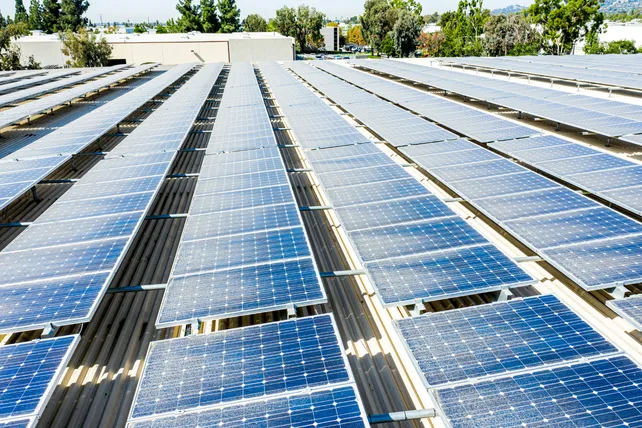
As commercial electricity costs continue to rise and businesses seek greater energy independence, integrating battery storage with commercial solar systems has become increasingly attractive for UK companies. This combination offers enhanced energy security, improved cost management, and greater flexibility in energy usage patterns.
Benefits of Solar-Storage Integration for Business
Combining solar panels with battery storage creates a comprehensive energy solution that addresses the limitations of standalone solar systems. The primary advantage is energy independence — businesses can store excess solar generation during peak production hours and use it during periods of high demand or low solar output.
Cost management benefits are significant. Battery storage allows businesses to avoid peak electricity tariff rates by using stored solar energy during expensive periods. This is particularly valuable under Time of Use tariffs, where electricity prices vary throughout the day based on grid demand.
The system also provides grid services revenue opportunities. Commercial battery systems can participate in National Grid ESO flexibility services, generating additional income streams through services like frequency response and capacity market participation, subject to minimum capacity requirements.
Energy security is enhanced through backup power capabilities. During grid outages, integrated storage systems can maintain power to critical business operations, reducing downtime costs and operational disruption.
Battery Technology Options and Compatibility
The commercial energy storage market offers several battery technologies, each with distinct characteristics and applications. Lithium-ion batteries dominate the commercial sector due to their high energy density, declining costs, and compatibility with solar inverter systems.
Lithium iron phosphate (LFP) batteries are particularly suitable for commercial applications, offering enhanced safety characteristics and longer cycle life compared to other lithium chemistries. These systems typically provide 6,000 to 10,000 charge cycles with minimal capacity degradation.
Battery management systems (BMS) are crucial for safe operation and optimal performance. Commercial installations require sophisticated BMS technology that monitors cell voltages, temperatures, and current flows while managing charging and discharging cycles to maximise battery lifespan.
Compatibility with existing solar installations varies by system design. DC-coupled systems connect batteries directly to solar panels through charge controllers, offering higher efficiency for solar charging. AC-coupled systems connect via grid-tie inverters, providing greater flexibility and easier retrofit installation.
System Sizing and Design Considerations
Proper sizing requires careful analysis of business energy consumption patterns, solar generation profiles, and financial objectives. The optimal battery capacity typically ranges from 0.5 to 2 hours of peak demand coverage, depending on load patterns and tariff structures.
Load analysis is fundamental to effective system design. Businesses need detailed energy consumption data covering at least 12 months to identify patterns, peak demands, and opportunities for battery deployment. Half-hourly meter data provides the granular information necessary for accurate sizing calculations.
Solar generation profiles must align with battery capacity to ensure effective utilisation. Oversized battery systems relative to solar generation may not achieve sufficient cycling for economic viability, while undersized storage fails to capture available solar excess.
Site constraints include available space, structural loading capacity, ventilation requirements, and electrical infrastructure. Commercial battery systems require dedicated plant rooms or outdoor containers with appropriate environmental controls and safety systems.
Future expansion considerations should influence initial design decisions. Modular battery systems allow capacity increases as business needs evolve or as battery costs continue declining.
UK Regulations for Commercial Energy Storage
Commercial energy storage systems must comply with multiple regulatory frameworks covering electrical safety, planning requirements, and grid connection standards. The Electricity Safety, Quality and Continuity Regulations 2002 establish fundamental safety requirements for electrical installations connected to the distribution network.
Building Regulations Part P covers electrical work in commercial buildings, requiring qualified electricians for installation work. Battery systems must also comply with relevant British Standards, including BS 7671 (IET Wiring Regulations) for electrical installations.
Planning permission requirements vary by installation size and location. Battery containers may require planning consent depending on local authority policies and site-specific factors such as conservation areas or listed building designations.
Grid connection requires compliance with Distribution Network Operator (DNO) standards. The Energy Networks Association G99 standard governs connection requirements for generating plant including battery storage systems. Applications must demonstrate compliance with technical specifications and protection requirements.
Installation and Grid Connection Requirements
Professional installation by qualified commercial solar installers ensures compliance with safety standards and regulatory requirements. Installation teams must include certified electricians with experience in both solar and battery storage systems.
Grid connection procedures begin with DNO application submission, including technical specifications and protection settings. For larger installations, this may require detailed studies of network impacts and upgrade requirements.
Protection and safety systems are mandatory for grid-connected storage. These include isolation switches, protection relays, and anti-islanding devices that disconnect the system during grid faults. Fire suppression systems may be required depending on battery technology and installation location.
Commissioning involves comprehensive testing of all system components, protection settings verification, and performance validation. This includes witness testing by DNO representatives for larger installations.
Ongoing maintenance requirements include regular inspection of electrical connections, battery monitoring system checks, and periodic testing of protection devices. Maintenance contracts with qualified service providers ensure optimal performance and regulatory compliance throughout system lifetime.
Cost Analysis and Financial Returns
Commercial battery storage economics depend on multiple revenue streams and cost factors. Capital costs for commercial lithium-ion systems typically range from £300 to £600 per kWh of usable capacity, excluding installation and associated electrical work.
Bill reduction savings come from peak shaving, time-of-use optimisation, and reduced grid import charges. Businesses on half-hourly settlement can benefit from Triad avoidance, reducing transmission charges based on peak demand periods.
Additional revenue opportunities include export sales through the Smart Export Guarantee for smaller systems, and grid services participation for larger installations. Frequency response services can generate £10-20 per kW per year, subject to performance requirements and market conditions.
Payback periods for integrated solar-storage systems typically range from 6 to 12 years, depending on energy usage patterns, tariff structures, and available revenue streams. Enhanced Capital Allowances may provide tax benefits for qualifying energy storage installations.
Financial modelling should account for battery degradation, typically 1-3% capacity loss per year, and potential technology refresh requirements over the system's 20-year operational life.
Ready to explore commercial solar and storage integration for your business? Connect with qualified commercial solar installers through nu.energy to discuss your specific requirements and receive tailored proposals for integrated energy solutions.